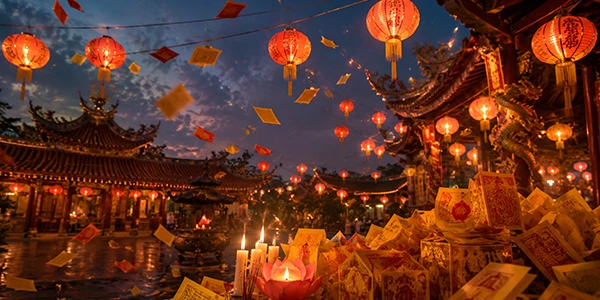
Every year, as the seventh month of the lunar calendar begins, many Chinese communities enter a period traditionally known as Ghost Month. The month is also closely associated with the Zhongyuan Festival and Hungry Ghost Festival, an important period for remembering ancestors, making offerings and showing respect to those who came before us.
When people hear about Ghost Month taboos, they may immediately think of superstition. However, if we look at these customs from another perspective, many traditions passed down through generations also contain lessons about personal safety, hygiene, psychological wellbeing, respect for others and awareness of our surroundings.
Traditional Feng Shui philosophy recognises that different seasons and periods can have different energetic qualities. The seventh lunar month is traditionally regarded as a period when Yin influences are more noticeable, so people are encouraged to behave with greater awareness and caution.
The purpose is not to spend the entire month feeling frightened. Rather, these customs remind us to act respectfully, pay attention to safety and avoid unnecessary problems caused by carelessness.
Below are ten of the most commonly mentioned traditional taboos of the seventh lunar month, together with some of the practical and Feng Shui ideas behind them.
10 Traditional Ghost Month Taboos
1. Avoid Walking Alone in Isolated Places at Night
Traditional belief holds that Yang energy becomes weaker at night, while Yin energy is considered more noticeable during the seventh lunar month. For this reason, people are often advised not to walk alone late at night, especially elderly people, children and pregnant women.
Chinese folklore also speaks of the three flames carried by a person: one above the head and one on each shoulder. These flames symbolically represent a person's Yang energy, vitality and spiritual protection. Traditional belief says that when a person's energy is weak, particularly late at night, they may become more sensitive to outside influences.
There is also a very practical reason for this advice. Visibility is poorer at night, fewer people may be around, and elderly people or children may face a higher risk of falls, becoming lost or being involved in accidents.
If you need to go out at night, travelling with someone else is preferable. Avoid very isolated streets and do not approach roadside rituals or offerings simply out of curiosity.
After returning home, washing your hands and face and changing your clothes can provide a simple transition from the outside environment back into the comfort of the home.
2. Avoid Whistling at Night
Older generations often advise people not to whistle at night during Ghost Month.
Traditional belief says that the sharp and distinctive sound of whistling can travel a long distance through a quiet environment and may attract unwanted attention. It is particularly discouraged in dark or damp places such as beneath staircases, beside large trees, in back lanes or near bathrooms.
From a practical perspective, the surroundings are much quieter at night, and a sudden high-pitched whistle can easily frighten people or disturb nearby residents.
This taboo does not necessarily need to be interpreted as meaning that something supernatural will appear simply because someone whistles. It can instead be understood as a reminder to respect the quiet of the night and the environment around us.
3. Do Not Leave Clothes Outside Overnight
Traditional belief holds that clothing worn close to the body easily carries a person's personal energy. For this reason, some families avoid leaving clothes hanging outdoors overnight during the seventh lunar month.
Clothing belonging to children and elderly family members is sometimes given particular attention and may be brought inside before sunset.
There is also a practical explanation. Humidity often rises overnight, and clothing that seemed dry earlier may absorb moisture again. Wearing damp clothes can be uncomfortable, particularly for elderly people or those with sensitive joints.
Clothes moving in the wind after dark may also resemble a human figure from a distance and unnecessarily frighten people passing nearby.
For both traditional and practical reasons, bringing washing indoors before nightfall can therefore be a sensible household habit.
4. Do Not Pick Up Money, Red Packets or Unidentified Objects
During the seventh lunar month, people are traditionally advised not to pick up coins, red packets, food offerings, dolls or unfamiliar objects found beside the road.
Folk belief says that some objects may have been deliberately placed there as part of a ritual, offering or symbolic act, so they should not be disturbed.
Even without considering spiritual beliefs, unidentified food and objects can present hygiene, safety and ownership issues.
Sealed red packets in particular are best left alone rather than opened out of curiosity.
The simplest rule is: if something does not belong to you, do not take it home simply because you found it.
5. Do Not Suddenly Slap Someone on the Shoulder
According to the traditional belief in the three flames, two of those protective flames are located on the shoulders. For this reason, some people are particularly cautious about strongly tapping or slapping another person's shoulders during Ghost Month.
There is also a very practical lesson behind the custom.
If someone is concentrating, bending down to pick something up or unaware that another person is behind them, a sudden slap on the shoulder can seriously startle them. Elderly people, children or anyone with poor balance may even lose their footing.
If you need someone's attention, call their name first and allow them to turn around before speaking to them.
For the same reason, suddenly shouting someone's name from directly behind them at night is traditionally discouraged. Whether or not a person follows the spiritual explanation, avoiding unnecessary fright is simply considerate behaviour.
6. Avoid Swimming or Fishing in Isolated Waters at Night
Traditional Chinese belief associates water strongly with Yin energy. For this reason, swimming or fishing at isolated beaches, rivers, reservoirs or other bodies of water after dark is often discouraged during the seventh lunar month.
However, the most important reason to follow this advice is personal safety.
Visibility is poor at night, and it can be difficult to judge currents, depth, rocks, tides and changes in water temperature. Even an experienced swimmer cannot completely control the conditions of a natural body of water.
If you want to swim, choosing a supervised swimming pool or patrolled beach with appropriate lighting and safety facilities is a much safer option.
The same applies to fishing. Avoid going alone to isolated waters, particularly at night or during unstable weather.
The traditional Chinese idea of respecting water ultimately reminds us to maintain humility and respect towards the power of nature.
7. Avoid Constantly Talking About Ghosts or Frightening Children
During the seventh lunar month, some people enjoy discussing supernatural stories, watching horror films or deliberately frightening friends and family members.
Traditional belief warns that constantly talking about spirits may attract unwanted attention. From a psychological perspective, however, the more important issue may be the effect of suggestion and expectation.
If a person continually thinks about frightening subjects, the mind naturally becomes more alert to related sounds and images. A cat moving outside, leaves blowing in the wind or an unfamiliar sound may suddenly appear frightening simply because the mind is expecting something unusual.
Children should especially not be frightened with threats that ghosts will come and take them away if they misbehave. Using fear repeatedly as discipline may create unnecessary anxiety about darkness or being alone.
Reducing excessively frightening entertainment at night and maintaining healthy sleep can be far more beneficial than becoming preoccupied with methods of spiritual protection.
8. Do Not Step on Ritual Ashes or Disturb Offerings
During the seventh lunar month, many families make offerings to their ancestors or participate in traditional rituals.
If you see incense, burnt joss paper, ashes or offerings on the ground, it is respectful to walk around them rather than stepping on, kicking, touching or removing them.
The most important principle here is respect.
Whether or not you personally follow the tradition, these items may represent another family's remembrance of their ancestors and loved ones. In the same way that we behave respectfully around another person's religious ceremony, wedding or funeral, we should show appropriate consideration towards traditional offerings.
It is also courteous not to take close-up photographs or videos of private ceremonies without permission.
If a child accidentally steps on an offering, there is no need to panic. Simply explain that the objects belong to another person's ceremony and teach the child to treat them respectfully.
9. Consider Avoiding Weddings, Housewarmings and Major Decisions
Traditionally, fewer weddings, grand openings, housewarmings and major celebrations are arranged during the seventh lunar month.
Some people also prefer to postpone large birthday celebrations, major contracts, new business ventures or important investments.
This belongs more to traditional Chinese date-selection culture and does not mean that nothing important can be done during Ghost Month.
If a date has already been arranged, there is no reason to assume that something bad will happen. For genuinely important decisions, proper preparation, accurate information and rational judgement are more important than the month alone.
If you or your family place great importance on traditional customs and have flexibility, you may choose another date. If changing the date is impractical, there is no need to become convinced that the event will be unlucky.
10. Avoid Moving House or Beginning Major Renovations Where Possible
Traditional Feng Shui regards moving house as a significant change in a person's living environment and personal energy, while major renovations involving drilling, demolition and structural work can temporarily disturb the existing Qi of a property.
For this reason, some families prefer not to begin major renovations or move house during the seventh lunar month.
Small essential repairs, such as replacing a light, fixing a tap or resolving a necessary household problem, are generally different from major construction or demolition.
If your moving date has already been arranged, there is no need to become excessively worried.
Before moving in, thoroughly clean the property, open doors and windows for ventilation and allow plenty of natural light inside. Once you move in, boiling water, switching on the lights and arranging furniture can gradually bring warmth and everyday activity into a previously empty home.
Even without considering Feng Shui, these practices can improve ventilation, cleanliness and the overall comfort of a new home.
Three Groups Traditionally Encouraged to Take Extra Care
In addition to the ten traditional taboos, three groups are often encouraged to take additional care during the seventh lunar month.
Elderly People
Older people may have less physical strength and slower reactions than younger adults. Avoiding unnecessary late-night trips, poorly lit areas and isolated locations is therefore sensible. Homes should also have adequate lighting to reduce the risk of falls.
Children
Children can be strongly influenced by their surroundings and by what adults tell them. Avoid taking them to isolated or unsettling places late at night, and avoid frightening them with supernatural stories.
Pregnant Women
Traditional belief regards pregnancy as a particularly sensitive period. Pregnant women are therefore often encouraged to avoid excessive fatigue, very late nights and unnecessary visits to isolated locations.
From a practical perspective, the advice for all three groups shares the same principles: personal safety, adequate rest and maintaining a calm state of mind.
What Can You Do During the Seventh Lunar Month?
Ghost Month is not only about avoiding things. Traditional culture also encourages several positive practices.
- Do good deeds and help others. Instead of spending the month worrying about bad luck, focus on positive actions you can control. Helping others, supporting charitable causes and caring for family members can create a more positive environment.
- Remember your ancestors. One of the central meanings of the Zhongyuan Festival is remembrance. Honouring ancestors does not necessarily require an elaborate ceremony. Gratitude and remembering where we came from are more important.
- Keep the home bright, clean and ventilated. Open windows, allow natural light into the home and remove unnecessary clutter. A clean and comfortable environment can improve mood, sleep and general wellbeing while also supporting healthy Feng Shui Qi flow.
The Most Important Principle Is Respect, Not Fear
The traditional taboos of the seventh lunar month should not be interpreted as a frightening list of things people are forbidden to do.
When these long-standing customs are considered carefully, most can be reduced to a few simple principles:
- Respect nature.
- Respect tradition.
- Respect our ancestors.
- Respect other people.
- Respect our own safety.
Feng Shui should be understood as part of traditional cultural guidance rather than something that controls every aspect of life. Our behaviour, choices and state of mind remain far more important.
There is therefore no need to approach the seventh lunar month with excessive fear.
Maintain good intentions, act carefully, respect the people around you and take good care of yourself and your family. These are among the most practical ways to create greater harmony and peace of mind during Ghost Month.
When the mind is peaceful, life naturally feels more settled.